Showing posts with label human rights. Show all posts

Saturday, June 25, 2011

New York State Republicans show Obama the way on same-sex marriage

By Richard K. Barry

I'm certainly proud of my home state of New York today, which voted yesterday to legalize same-sex marriage 33 to 29. The measure was able to pass because four members of the Republican majority joined all but one Democrat in the Senate to support the measure.

Of note were comments made by Sen. Mark Grisanti, a GOP freshman from Buffalo, who had been undecided saying that he could not deny anyone basic human rights. He continued by saying that "I apologize to those I offend. But I believe you can be wiser today than yesterday. I believe this state needs to provide equal rights and protection for all its residents."

In changing his vote, GOP Sen. Stephen Saland said that "while I understand that my vote will disappoint many, I also know that my vote is a vote of conscience. I am doing the right thing to support marriage equality."

The legislation was signed last night at 11:55 p.m. by Gov. Andrew M. Cuomo, and will go into effect in 30 days, which means that same-sex couples will be able to marry in New York by late July.

Currently five states allow same-sex marriage: Vermont, Connecticut, Massachusetts, New Hampshire and Vermont, as well at the District of Columbia.

There would appear to be no greater indication of a sea change on the issue than that only two years ago the New York State Senate, then controlled by Democrats, easily rejected the measure but now a Republican controlled Senate has passed it.

The difference, of course, is that Gov. Cuomo has made this a priority and used his significant resources and political capital to help make it happen.

Of great significance as well is that public opinion is changing. As the New York Times reports:
In 2004, according to a Quinnipiac poll, 37 percent of the state's residents supported allowing same-sex couples to wed. This year, 58 percent of them did.
Just in terms of the raw politics involved, New York is by far the largest state to have passed legislation to recognize same-sex marriage and, as the Times writes, "is home to a large, visible, and politically influential gay community." The implications are huge.

But dozens of other states have constitutional amendments or laws banning same-sex marriage and the issue is sure to be a part of the landscape in the culture wars that have been and will continue to define the 2012 election cycle.

Which, of course, brings us to President Obama, who addressed more than 600 donors at a fund-raiser on Thursday night of the LGBT Leadership Council Gala in New York City, many of whom probably thought they would hear something different from the President given recent reports of his "evolving stance" on marriage equality.

Alas, that was not to be, as he offered only mention of past accomplishments on same-sex equality without in fact getting close to adding marriage to the list.

I do understand politics and I understand that America is a big country with complex national political dynamics, but if Republican legislators can stand up and say that they have decided to support same-sex marriage simply because it is the right thing to do, then the man who promised to bring us hope for a better future should be able to do the same thing.

I'm getting a little tired of this act. When four GOP New York State Senators are out ahead of you, Mr. President, on issues of basic human rights, it's time to stop evolving and start acting. When Republicans decide that they must risk their own political future to do the right thing on something so fundamental, you might want to think again about your own position.

C'mon. Surprise us.

Below is a clip of Sen. Grisanti giving reasons for his changed vote.


(Cross-posted to Lippmann's Ghost.)

Monday, May 16, 2011

Why we need Ron Paul

By Capt. Fogg

I rather hope Ron Paul becomes the Republican presidential candidate in the next election. It's true that I agree with some of what he says, some of it quite strongly and it's true that I disagree as well and just as passionately, but if he is Barack Obama's challenger, the nature and tone of the debates and the wider campaign will have to address some fundamental assumptions that always are ignored. One of the many fundamentals that separate the left from the new right is the ranking of rights in our society. Paul asserts what most of his party would rather hide beneath heaps of polemical hyperbole: that Property rights are the basis of freedom and being thus fundamental, must not be abridged for the common good.

I'm one of those people, you see, who thinks all ethics, or at least all ethical judgements are situational and that what we like to call fundamentals is an abstract construct, a bit like Euclidean geometry, which is immune from other, perhaps decisive factors. Parallel lines do indeed intersect in a universe with curvature and morally clear decisions become less clear when they have to cope with the purpose of morality and ethics.

Speaking to Chris Matthews last week, Representative Ron Paul (R-TX) declared that he would not have voted for the 1964 Civil Rights Act -- not because he's a racist, and to be sure he says he would have desegregated government institutions like schools, but because the rights of property owners are fundamental to our basic freedoms; freedoms that our constitution implies, property rights are rights inherently and independently fundamental as they stand. Is he insisting that those with no property have fewer or no rights? That's up to him to clarify and I expect he would like the opportunity.

“I believe that property rights should be protected,”

says the man from Texas. Who would disagree when presented in the abstract? But life isn't an abstract thing and may I defend building a nuclear waste dump next to Manhattan because of that declared axiom? Are property rights part of a constellation of rights all designed by humans to make human life free of certain abuses? Are rights, like Newton's laws, fundamental or descriptive? If they are things invented by the people and for the people, to what purpose were they invented; to protect the one against the many or the many against the one or both? Do they apply equally at all points on the long curve or are only around the middle where we experience things?

I'm sure Paul would have to admit with liberals, that there are limits to "fundamental" rights, but just what those are and for what reason those limits are put there, needs to be dragged out of the cave and into the light. Do rights exist for the benefit of people and if so does the right of one man always trump the right of every man? Are we here for the law or is the law here for us? Do the rights of all really flow from the rights of an individual or are individual rights sometimes an impediment? If there is an impediment to that road to life, liberty and pursuit of happiness, must 300 million of us endure it so that the abstract right of one may be protected? Yes, that's extreme, but as with Newton's laws, it's the extremes that absolutes are shown not to be so absolute. In short, can Libertarian theory produce a country that any of us will want to live in - in whole or in part?

(Of course if I were to debate him, I would, in my quasi-deconstructionist way ask him what he means by property and whether that question isn't more fundamental because without asking that, defending property rights can defend slavery or rape and some slightly worse things.)

We need to talk about it. We've been stuck at this point for too long. These concerns aren't new and they aren't going away and we all need to rethink our opinions at a fundamental level as a regular practice. I think Paul and Obama are both well qualified to do it and will do it -- and if we have to endure another hysterical fugue about flag pins and death panels and birth certificates and Communism aimed at the stupidest elements of the population; lies and slander and tactical statements of opinion that a moment may reverse - - well let's just say that the civil war doesn't need to be fought this way again.

(cross posted to Human Voices)

Wednesday, December 10, 2008

Around the World: Zimbabwe, Belarus, Greece, Russia, and Turkey

By Michael J.W. Stickings

This, apparently, is Post #6,000 at The Reaction. I suppose that's a milestone of sorts. Let's use the occasion to do another installment of our Around the World series (which we haven't done in some time):

1) Zimbabwe: "A cholera epidemic is sweeping across Zimbabwe, causing further suffering to millions of people already struggling to survive in a country close to systemic collapse as food shortages and hyperinflation continue to take their toll." It's pretty grim, to say the least -- and, as the BBC notes, it does not even have permission to report from Zimbabwe.

2) Belarus: "Police have arrested dozens of opposition activists across Belarus after a series of protests marking international Human Rights Day." Oh, what a lovely dictatorship. (And such irony: human rights abuses on Human Rights Day.)

3) Greece: "Riot police battled protesters outside Greece's parliament and in Athens suburbs yesterday while opposition socialists called for the conservative government to step down to end the worst civil unrest in decades." It's a complicated situation, but, essentially, students have risen up against the government of conservative Prime Minister Kostas Karamanlis in the wake of the killing of a 15-year old boy by police. As the editor of one of the country's leading newspapers put it, the killing "It will quickly become a flag of convenience for anyone who has a grudge against the state, the government, the economic system, foreign powers, capitalism and so on." More here.

4) Russia: "[T]he Kremlin seems to be capitalizing on the economic crisis, exploiting the opportunity to establish more control over financially weakened industries that it has long coveted, particularly those in natural resources." Putin's authoritarian centralization -- and, make no mistake, he's still in charge -- is disturbing, but it's not like the alternative, the rule of the oligarchs and the various other corrupt and criminal elements that dominate Russian society, is terribly appealing either.

5) Turkey: "Amid corruption scandals and stagnating reform, Turkish Prime Minister Recep Tayyip Erdogan, praised in Europe as a modernizer, is seeking refuge in nationalist rhetoric, adopting a tougher stance on the Kurds and moving closer to the country's military leaders." It is nationalism, and not so much patriotism, that is the last refuge of the scoundrel, and certainly of the desperate politician seeking to distract public attention away from what really matters. Yet again, and so predictably, it's the glorification of the Self (us) and the vilification of the Other (them). And, in this case, it could put a halt to Turkey's pro-European modernization efforts and lead to further destabilization in northern Iraq (Kurdistan).

Thursday, November 27, 2008

Some People Will Be Hungry This Thanksgiving - Reprise

By Carol Gee

Thanksgiving Day 2008 -- Bountiful tables, full tummies, excess leftovers characterize many of our Thanksgiving feasts. On one of our favorite holidays in the United States, we give thanks for all we have. Today's post is an updated republication of a post that has remained popular since it first appeared in 2005. I begin with an update:

An economist's view -- "The world financial, food and hunger crisis" by Lane Vanderslice from World Hunger Notes (updated Nov. 11, 2008). Some points:

  1. The world food crisis has been replaced in large part by the world financial crisis.

  2. . . . food prices have soared. . . rice, the staple food of billions of people, more than doubled from 2003 through March 2008. . . This is a crisis for the poorest people in the world. 2.6 billion people live on $2 a day or less. They spend approximately 50 percent of their income on food.

  3. [Causes] What are key factors affecting the supply of food? [On] Demand side: There has been strong economic growth for the world economy over the past 10 years or so. . . the quantity people demand of food does not vary much with changes in prices. . . Commodity speculation has been widespread.

  4. Supply side: A major factor affecting the supply of food has been the diversion of crop land to fuel production. . . the agricultural production of developing countries is now directed to a greater extent toward producing for export to developed countries rather than to producing goods for their own people. . . There have also been certain shortfalls in production. . . Assistance to agriculture by developed countries and multilateral development banks has been minimal, and, though some countries have adequately supported their agriculture sector including India and China, others have not, including many and perhaps most countries of Africa. Agricultural producers, especially the poorest, in Africa and elsewhere have been exploited or neglected by governments. Assistance to agriculture by developed countries and multilateral development banks has fallen dramatically.

Wikipedia page "Malnutrition" 2008 -- has what appears to be some good entries. For example:

Some environmentalists claim that the fundamental issue causing malnutrition is that the human population exceeds the Earth's carrying capacity;[5] however, Food First raises the issue of food sovereignty and claims that every country (with the possible minor exceptions of some city-states) has sufficient agricultural capacity to feed its own people, but that the "free trade" economic order associated with such institutions as the International Monetary Fund (IMF) and the World Bank prevent this from happening. At the other end of the spectrum, the World Bank itself claims to be part of the solution to malnutrition, asserting that the best way for countries to succeed in breaking the cycle of poverty and malnutrition is to build export-led economies that will give them the financial means to buy foodstuffs on the world market.

World Hunger Notes is a fabulous resource for the latest news about world hunger. For example:

The original post -- Some Will Be Hungry This Thanksgiving -- Nov. 23, 2005

How does it feel to be hungry, really hungry? It is not the kind of hunger that comes with having missed a meal. It is also not the kind of hunger one feels when doing a very purposeful "cleansing fast," or fasting on Fridays, in the old days of an observed liturgical holy week.

This hunger is that which comes from not getting anything to eat, or very little to eat, on a regular basis for days, weeks, months or years at a time. It comes from not getting a nutritionally balanced diet. This kind of hunger makes it difficult, if not impossible for mothers to nurse their infants. Infants do not grow and thrive if they live. People - adults and children - starve to death, or they die of diseases brought on by malnutrition. There are entire nations starving or desperately endangered today; right now. And there far too many people in these United States that are also hungry. This week, this coming Thanksgiving Day, the weekend following , millions are hungry. For many of the rest of us, we will be trying to figure out what to do with all our leftovers.

A recent Reuters story focused on the just published United Nations report on hunger in the world which states that 6 million children a year die from hunger related causes. (see also the terrific pop up map in the title link above) Quoting Reuters,

Most of the 6 million child deaths a year are not due to starvation but
rather to neonatal disorders and diseases like diarrhea, pneumonia, malaria and measles which would be easily curable if the victims were not weakened by lack of nutrition.

The food crisis brought about by climate change is also part of the larger hunger picture. The BBC article begins,

Climate change threatens to put far more people at risk of hunger over the next 50 years than previously thought, according to new research. Scientists say expected shifts in rain patterns and temperatures over that time could lead to an extra 50 million people struggling to get enough food.
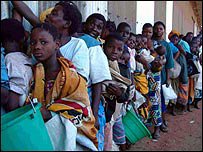
(BBC image) In Africa people in Malawi face a maize crisis. Quoting,

The worse harvest in a decade and failed rains are being blamed for what aid agencies warn is a rapidly emerging food crisis. What is making matters worse is HIV/Aids. One in seven people in Malawi is affected and it is fueling the problem of extreme hunger. Money that households would normally spend on buying seed and fertiliser, is being spent on transporting the sick to hospital and buying basic medicine instead.

In Zimbabwe even their own soldiers are hungry enough that there are shortages of food in the barracks and forced leaves. High food prices are a factor in Niger's hunger problems, because of the high demand for food in the surrounding countries. The crisis of African hunger was debated in this BBC feature; some of the discussion comments were excellent. Millions are at risk in Africa, but so are millions in southern Asia.

Earthquake survivors face winter hunger in the Kashmir area. It is a major crisis for the millions left homeless by the quakes in Pakistan, Kashmir and India. The article states, "As of 16 October, food had reached 440,000 people but an estimated 560,000 remained in "desperate need of assistance".

In our own hemisphere hunger is a major problem in several contries. The BBC reports that Guatemalans face hunger as a result of the recent natural disaster, Hurricane Stan. Rats ate the crops of many people in Nicaragua, one of the poorest nations in the Central America. The BBC article headlines, "The UN is to send 230 tons of emergency food aid to thousands of Miskito Indians facing hunger in Nicaragua."

Here at home, the Food Research and Action Center is an excellent site for exploring hunger in the United States. America's Second Harvest, the nation's food bank network, has excellent material on hunger in the U. S. The Children's Defense Fund explores the question of U.S. children's hunger in this 6-page PDF document. Here is what the USDA site has to say about "food security" in the U.S.:


Eighty-eight percent of American households were food secure throughout the entire year 2004, meaning that they had access, at all times, to enough food for an active, healthy life for all household members. The remaining households were food insecure at least some time during that year. The prevalence of food insecurity was 11.9 percent in 2004, up from 11.2 percent in 2003. The prevalence of food insecurity with hunger was 3.9 percent in 2004, up from 3.5 percent in 2003.

Since our population was 290,342,554 in July of 2003, the "3.9% of food insecurity with hunger" translates into 11, 323,360 hungry people in the United States. Is there anything that can be done about the recent increase in hunger? The above paragraph on hunger in America includes several references in the linked articles to organizations that endeavor to feed people who go to bed hungry. In your own city, there is probably a food bank, a soup kitchen or a homeless shelter that could use some help, either volunteering or donating. And many churches, synagogues and mosques as well as other faith based organizations focus of food pantries or feeding programs.

World wide, diminishing poverty and the predominance of violence and war will help. Improvements in agriculture are key to the long term solution. For example, unraveling the DNA code of the rice genome may be an answer for many countries where rice is the predominant staple.

Reference: Wikipedia's excellent section on hunger discusses many aspects of the problem and includes links to many organizations that work on hunger.

(Cross-posted at South by Southwest.)

Wednesday, July 23, 2008

The 1988 Massacre in Iran

By non sequitur

Here's an important article about a horrendous massacre of Iranian dissidents in 1988. As the author points out, it meets all the requirements to be formally classified as a crime against humanity, but is still almost entirely unknown outside of Iranian dissident circles. The author, Kaveh Sharooz, has done a lot of the important and original research into this massacre, and published some of his findings in the Harvard Human Rights Journal. The article contains a link to that piece.

Here's a brief account of the massacre, from the article (because of the length of the quote, I'm not going to use the usual quoting mechanism here).

**********

In late 1987 and early 1988, prison officials began the unusual process of interrogating political prisoners again and separating them according to their party affiliations, religiosity, and length of sentence. In Tehran, this meant that some prisoners were moved between Evin and Gohar-Dasht prisons. This preliminary segregation of prisoners strongly indicates that there were pre-existing plans for mass killings. Furthermore, the filtering process belies the notion that the 1988 executions were in response to armed attacks on Iranian territory.

At the end of July 1988, shortly after Iran had accepted a cease-fire in the war with Iraq, and days after its military had soundly repelled an attack by the Mojahedin-e Khalq on Iran's western border, Ayatollah Ruhollah Khomeini gave two unprecedented secret orders(2) to begin the re-trial of all political prisoners across the country and to execute those who remained steadfast in their opposition to the Islamic regime. To give effect to Khomeini’s order, a commission was assembled -- called the "Death Commission" by the prisoners -- consisting of a representative from the Judiciary, the office of the Prosecutor, and the Ministry of Intelligence. In Tehran's Death Commission, those government agencies were represented by Jaafar Nayyeri, Morteza Eshraghi and Mostafa Pourmohammadi respectively, although others also played a role. The task of the Death Commission was to determine whether a prisoner was a Mohareb ("Combatant against God") or Mortad ("Apostate") -- and to execute both groups. In the case of most Mojahedin prisoners, that determination was often made after only a single question about their party affiliation. Those who said "Mojahedin" rather than the derogatory "Monafeqin" ("Hypocrite") were sent to be hanged. In the case of various leftist prisoners, the Death Commission asked about religious belief and willingness to cooperate with the authorities. Sample questions included: "are you a Muslim?", "do you pray?", and "are you willing to clear minefields for the military of the Islamic Republic?" If a plurality of judges felt that the prisoner was a Mohareb or Mortad, the prisoner was sent to hang immediately.

Several thousand political prisoners were killed in a matter of two months. Ayatollah Hossein Ali Montazeri estimates that the number killed was somewhere between 2,800 and 3,800. Others believe the number is higher. Even those who survived the questioning of the Death Commission did not always fare well. Some could not bear the emotional pain of what they had witnessed, or the physical pain of the regular floggings they received, and simply committed suicide. The prison guards are said to have encouraged that decision.

To add insult to injury, the Iranian government did not inform the victims' families about the re-trials until the executions had been carried out and the bodies had been buried in mass graves. Once informed, the families were not told of their loved ones' burial spots and were ordered not to erect any monument or hold any ceremony. When asked about the killings by the Western press, representatives of the Iranian government -- Abdollah Nouri, Ali Khamene'i, and Hashemi Rafsanjani -- flatly denied them. The Iranian government continues to deny the 1988 elimination of opposition prisoners.

***

As mentioned at the outset, the murder campaign of that summer is a crime without parallel in Iran's tumultuous modern history. In fact, the executions have all the elements required by international law to be labeled as crimes against humanity: The murders were widespread and systematic, they were directed at a civilian population, and, as made clear by Ayatollah Montazeri in his memoirs, they were a policy preconceived at the highest ranks of the Iranian government. The sheer magnitude of the 1988 massacre makes it too large to ignore, even after twenty years.

**********

(Please read the whole thing, including the proposals for action.)

Thursday, July 17, 2008

Don't we look foolish enough already?

By Capt. Fogg

I don't think I want to watch the Olympics this year. It's not that this iteration of the games will be any more or less boring or fulsomely nationalistic than the event ever has been, but I'm afraid that some self-appointed ambassadors are going to make damn fools and hypocrites of us.

My first reaction was "tell me it's a joke" when I read the Reuters item telling us that an unspecified group of "human rights activists" have asked George W. Bush to complain to the Chinese government about political prisoners while he is there, and to wear a wristband that declares: "free the North Koreans." They intend to show up under full sail in Beijing wearing their version of the trendy rubber band rhetoric. I can almost hear the jeers.

Tell me it's a joke.

According to White House spokesman Gordon Johndroe, Bush will not be taking wristbands with him. I'm glad to hear it. Another thing George will not be taking with him on the trip is moral authority; or indeed anything else that gives him the right to demand that China not expel illegal aliens coming across the Korean Border looking for work, or that they release militant Islamic separatists, much less to extend them anything resembling the right to Habeas Corpus.

It's not that no criticism is due, it's that we are in no position to make it. I can well imagine my own feelings should a Chinese delegation show up here demanding that we free Puerto Rico, close Guantanamo and open the border with Mexico.

I mean, it's really a joke, isn't it?

(Cross-posted from Human Voices.)

Sunday, May 11, 2008

Baghdad before and after - Updated

By Libby Spencer

I think about Iraq a lot. Sometimes when I'm reading about the occupation, which I do for hours every week, I'm struck by a profound sadness that I never traveled there before the invasion. I always wanted to see the antiquities of Baghdad but many of its ancient treasures have been destroyed or ruined in the "liberation" so even if peace ever inflicts itself again on that city, it won't ever the same.

Not having a guidebook handy, I decided I wanted to see what it looked like before our bombs arrived. I discovered it's not that easy to find photos of Baghdad before the invasion. These were the best I could find. As you can see it was once a green and beautiful place.

baghdad before the invasion


Now, not so much. It's a broken city. [Click on the photos to enlarge them. I can't copy them full size.]

baghdad after

There's more shots from this photograher at this album and others have posted more. Iraq was beautiful before the 'war.' None of this will ever be the same.

I think a lot about the people of Iraq. I look at the shots at the last link, of ordinary people smiling, the kids with innocence still intact in their eyes and it breaks my heart. I haven't been able to get through the whole nine minutes yet. I find it physically painful to think of all those normal comfortable lives forever disrupted for the crass ambition of politicians.

Two weeks before the invasion Bahgdad was a happy place. The people smiled on the lighted streets, filled with sidewalk vendors and laughing party goers. An American traveler was safe to wander them at will. Now you need a flack vest and an armed guard to leave the Green Zone.

Two weeks before the invasion, the Tigris river was blue. Today it's a different color. The lights don't go on in the city at night. The remaining vendors stalls are nearly empty and no one laughs in the streets. This is the legacy our tax dollars have bought.

They tell me freedom isn't free and I believe it. We've paid dearly in blood and treasure in its name. But when we count up the cost, let's include the Iraqi people's loss in the price. It's been significant.

Update: Armed Liberal mocks my empathy and accuses me of romanticizing Saddam's regime. Spare me the horror stories. I suppose I could spend a half an hour assembling links in response but what would be the point? The warmongers lost any ground to argue about Saddam's brutality the day our government became a state sponsor of torture.

These pictures speak for themselves. The millions of displaced Iraqis who lost their homes and livelihoods and the families of the hundreds of thousands of dead and maimed suffered a great loss. No matter how you feel about the occupation, it's only common decency to acknowledge it and hiding behind Saddam's atrocities to excuse our own mistakes is pure cowardice.

(Cross-posted at The Impolitic.)

Saturday, May 10, 2008

Tortured Thinking, Part II -- the Witnesses

By Carol Gee


The House Judiciary Subcommittee on the Constitution, Civil Rights and Civil Liberties, held a hearing on the subject of torture this week. This eye-opening session was spotlighted in my May 8 post, "Tortured Thinking, Part I -- the Players." It was a summary of what House Members are seeking regarding what happened with the issue of detainee interrogations. Since the beginning of the administration, the subject of how to interrogate has been a problem. A number of legal memos have emerged, as well as the identities of the key players, top to bottom. Committee Democrats, chaired by Rep. Jerrold Nadler D-NY, and supported by the overall Committee Chairman, John Conyers D-MI, questioned a panel of legal experts, upon whom today's post focuses.

Chairman Nadler swore in a panel of witnesses who gave a more in-depth picture than we have previously known of our nation's recent history of "severe interrogation," what some see as torture. Witnesses included British law Professor Phillipe Sands and Georgetown Professor David Luban. Other witnesses were former administration Counsel's Office lawyer David B. Rivkin and Professor Marjorie Cohn, President of the National Lawyers Guild. Links to their prepared statements are included. Their statements are not covered here but summaries of the main points made by each, follow the Committee's questions:
  • Witness prepared statement: Philippe Sands, QC
    Professor of Law
    University College London
    Barrister
    Matrix Chambers
    .

    Professor Sands recently researched the history of Bush administration actions around the torture issue ; it is chronicled in his illuminating article, "The Green Light."
    Chairman Conyers asked Professor Sands about what else to do. The professor said, "The country is at an important moment, and it is best to eventually unite amongst ourselves and move on from 2002. We need to find out what actually happened, however, crucial facts about the military involvement must be found out and the CIA stuff remains, Sands said. He added that David Addington's testimony is pivotal due to his "deep involvement. He was the leader of the pack, driving the policy, assisted by DOJ Counsel Haynes." Sands recounted the trip that Addington and a group of high administration officials took to visit Guantanamo "to see the place and the detainee causing all the difficulty, Mohamed al-Khatani, whom they thought was the 20th hijacker."
    Rep Mike Pence R-Indiana asked about the British experience of 15 years of bombs and the IRA. Sands said having so many lives on the line is the "heart of the matter" in every country that deals with terrorism. Sands said that the British military eventually came to consensus that coercion of detainees does not work, just as did the U.S. military and the FBI. U.K. authorities "tried all the hooding, etc. in the 1970s, and it created outrage that extended the conflict with Ireland for 15 extra years." Sands urged dropping the term "war on terror" because it makes the extremists into "warriors" and creates "good recruitment arguments." Sands noted that President Bush, unfortunately, doesn't ask advice from other countries.
    Rep. Artur Davis, D-Alabama, had an excellent discussion with Sands about the fact that Israel has fore-sworn torture, feeling that their democracy is stronger. Sands also said the the "ticking time bomb theory is completely hypothetical."
    Rep. Darrell Issa R-CA's discussion elicited from Professor Sands that, "The Army Field Manual is a sensible guide to use for interrogation. Sands regrets that the President vetoed good legislation prohibiting the use of water-boarding. He also recounted a conversation with an unnamed foreign head of state, who pulled a copy of the Yoo memo out of his pocket and asserted to Sands, "Why not do it?"
    Rep. Keith Ellison D-MN asked Phillipe Sands the question, "Does torture work?" Sands recounted his 1 and 1/2 years of investigation of the interrogation of one man, the so-called 20th hijacker, al-Khatani, "and the torture produced nothing. You cannot determine what is true with this method. For example, Khalid Sheikh Mohammed ("KSM," thought to have masterminded the 9/11 attacks) was tortured and confessed to everything. Coerced information leads to excluding the facts that are true.
    Rep. Bobby Scott D-VA asked Sands what is the affect of allowing troops to use torture. He answered, "Military morale is degraded, and exposes members of the military as well as U.S. nationals in foreign lands to higher risk from enemies." Sands reported that he has been contacted by many members of the military who are pleased by how the investigation is proceeding.
    Rep. Mel Watt D-NC asked what the committee should do next? Sands gave this advice. "Just document the facts needing exploration. Exercise prosecutorial discretion with your subpoenaes. The Committee can do this. Just ask all the lawyers about all the facts. Regarding other aspects, torture violates the Geneva Conventions. The U.S. has the obligation to investigate and prosecute or extradite officials to other countries who bring up charges against U.S. officials. "The U.S. must handle this or other countries will," he warned.
    Rep. Steve Cohen's D-TN questions to Sands elicited further leads from Sands to the Committee that should be investigated: for one, the high level of tension regarding
    the move towards aggressive interrogation at Guantanamo. Look into "Spike" Bowman's concerns that were brushed off by DOJ Counsel Haynes. Find out what Haynes' role was, what did he do to Khatani, and what did Donald Rumsfeld do? Sands said that Haynes already knew of Yoo's DOJ sign-off memo before the first trip to Guantanamo. Evidently, Haynes put the blame on two military officers, who've now been prosecuted. One was Diane Beavers who has been hurt by the public revelations, "outed." All these facts need to be investigated by this committee, Sands concluded. (See "The Green Light" article linked above to flesh out this imformation completely).

  • Witness prepared statement: David J. Luban
    Professor of Law
    Georgetown University Law Center

    Professor Luban was questioned by Chairman Nadler. Luban discussed the intervening Supreme Court's decision regrading the application of Common Article 3 of the Geneva Conventions to detainee treatment. He also elaborated on the legal memos' words about the whole concept of measuring physical pain. Saying that the "severe pain"
    definition, to which the torture memos referred, is a medical emergency that was taken out of the Medicare statutes. He also discussed the memos' idea that prohibited severe physical suffering had to be applied if "prolonged." He noted that water-boarding usually takes just three minutes.
    Rep. Darrell Issa R-CA elicited the professor's information that, during interrogation death threats against the detainee's family are not legally allowed, but that some other kinds of lies to "trick-out information" is permissible, and even moral.
    Rep. Keith Ellison D-MN asked the question whether there had ever been an actual "ticking time-bomb" episode, and he replied that none has ever occurred that has been documented.
    Rep. Steve Cohen's D-TN questions to
    Luban also revealed that British Intelligence has admitted to using five of the 15 different severe interrogation techniques discussed during this hearing.
    Rep. Mel Watt D-NC
    asked, "what should be done about all this?" Luban recommended that we find out what really happened, including what techniques were actually used, publicize all the as yet unrevealed memos, get the full story out, go after legal ethics violations, but not get into the law-breaking aspects just yet, as that would be premature. He added that none of this has been a state secret for three years, denying that excuse to the administration.

To be continued -- "Tortured Thinking, Part III - the Final Witnesses." I encourage you to read "The Green Light" article for Sands' complete narrative of his year and a half investigation. I believe it to be very significant material because so many of the players were quite willing to talk to the professor about it.

(Cross-posted at South by Southwest.)

Friday, December 7, 2007

United Nations associated with Middle East news

By Carol Gee


President George W. Bush has never been an ardent supporter of the United Nations. He has only used the organization when it has been convenient, or as "cover" for his military adventure in Iraq. I am not sure why the administration now welcomes its presence at the Hamdan military tribunal proceedings now going on at Gitmo. The United Nations Office at Geneva is reporting that a special UN expert on human rights from Finland was invited to a December 5 military hearing at Guantanamo Bay

Martin Scheinin, issued the following statement today:

Geneva, 3 December 2007: -- The Special Rapporteur welcomes the invitation extended by the Government of the United States of America for him to attend and observe military commission hearings scheduled to commence on 5 December 2007 at Guantanamo Bay.

...The Special Rapporteur’s mission report on the United States is expected to be presented and considered by the resumed sixth session of the Human Rights Council in Geneva on 12 December. In addition to the presentation of his reports, the Special Rapporteur will report orally on his observations regarding his trip to Guantanamo Bay.

"Witnesses to Take Stand for First Time in Guantanamo Detainee Prosecutions," reports Fox News. After six years of detention the big news is about a long awaited tribunal hearing for the man suspected of being a driver for Osama bin Laden. Coincidentally at the same time, yesterday's Supreme Court session was on the rights of the Guantanamo detainees:

Witnesses are expected to take the stand Thursday for the first time since the U.S. government began attempts to prosecute terrorism suspects at Guantanamo.

An expert in Middle Eastern affairs is expected to testify for Salim Ahmed Hamdan to support the defense argument that he could have been a driver for bin Laden without being a hardcore Al Qaeda member with knowledge of terrorist attacks.

Prosecutors are expected to present about five witnesses to back their case that Hamdan should be charged as an unlawful enemy combatant, in the second day of pretrial hearings to determine whether the military tribunal at this isolated Navy base has jurisdiction over the case.

Evidently signals got crossed between Israel and the U.S. State Department recently. Again it was about on what use to make of the United Nations, not how to see them as partners with any standing. From JTA.org, "the global news service of the Jewish people," comes the interesting headline, "Envoy: Israel asked U.S. to pull draft":

Israel asked the Bush administration to pull a resolution hailing the Annapolis peace parley, said the U.S. ambassador to the United Nations.

Zalmay Khalilzad was on the hot seat this week after the Bush administration pulled a draft resolution on Nov. 30 hailing the peace conference that he had submitted to the U.N. Security Council.

Khalilzad told Reuters Tuesday that he believed the decision to pull the resolution came from “the highest level” of the Israeli government. Israeli and Palestinian officials said last week they had seen the draft resolution. Though the Israelis told the press they had no objection to the text, they argued that a Security Council resolution was an inappropriate measure.

The U.N.'s efforts to eradicate cluster bombs are back in the news. I wrote a post about these horrible weapons in September of 2006. Today's headline reads, "Conference on Cluster Munitions," to be held in Vienna, Austria, 5-7 December, 2007. The story came from Crisis Prevention and Recovery:

This third Conference on Cluster Munitions within the Oslo Process is another important step towards an intended international ban on cluster munitions that cause unacceptable harm to civilians. Some 118 countries are so far registered to participate in the Vienna conference which is an increase from the 68 states that attended the second conference in Lima in May 2007.

The UN has, on numerous occasions, appealed to the international community to address the inhumane effects of cluster munitions. On 17th September 2007, the UN established a position calling on Member States to address immediately the horrendous humanitarian, human rights and development effects of cluster munitions by concluding a legally binding instrument of international humanitarian law.

Examples of the impact of cluster munitions on civilians in the Middle East -- From the same organization, here is a summary of the cluster bomb impact on Afghanistan:

As a result of this 'area-contamination', the impact of cluster munition use extended beyond the immediate threat to personal security and safety. Cluster munitions destroyed homes and prevented their reconstruction until clearance could be undertaken. Agriculture was affected, as contamination extended over vineyards, walled gardens and wheat fields. Livestock was killed, and areas available for gathering vital resources, notably firewood, were restricted due to the presence of unexploded cluster munitions. 11 As has been noted in other locations, civilians were left with a choice between suffering a loss of livelihood and severely deprived living conditions, or risking their safety in order to generate income and gather resources.

To conclude today's post I quote from an earlier piece that sounds eerily familiar. It also addressing the U.S. vs. the United Nations and the Middle East. The title and entire concluding section I used then are still just as appropriate:

  • Views from a parallel universe -- July 17, 2007
    There is reality, and then there is "Bush reality." Many of us responded with a big yawn to the recent news of a call for peace by OCP...

    U.S. Middle East view trumps that of the U.N. -- Our State Department reports on OCP's "briefing" meeting with U.N. Secretary General Ban-Ki-Moon, as if he were a beginner needing to learn a thing or two:

    President Bush (July 17): "...One of the things I briefed the Secretary on was my views about extremism and these radicals that will do anything to disrupt the goals set by the United Nations and/or disrupt the advance of democracy in peaceful societies. Al Qaeda is strong today, but they're not nearly as strong as they were prior to September the 11th, 2001, and the reason why is, is because we've been working with the world to keep the pressure on, to stay on the offense, to bring them to justice so they won't hurt us again; to defeat them where we find them."

    So that is the Bush Middle East reality. And then we have the rational reality for which we can only wish -- intelligent, non-delusional, realistic about the facts, respectful of other Western leaders, honest and fair, consistent and timely, reasonable. I am not holding my breath for peace to break out in the Middle East any time soon.

(Cross-posted at South by Southwest.)

Wednesday, November 21, 2007

THE TASER CRAZE CONTINUES ???


DIDN'T THIS COP KNOW HE WAS ON VIDEO WITH SOUND ?
HE TELLS THE 2ND COP "I TOLD HIM TURN AROUND OR I'LL TASE YOU(THE LEGAL OBLIGATION)"
BUT THAT'S NOT WHAT HAPPENED ON VIDEO - DOOH !

Tuesday, November 13, 2007

One word: "waterboarding"

By Carol Gee

. . . was the subject of 29,300 posts carried by my news aggregator Bloglines this morning. The word simply will not go away. In fact, someone I know dreamed about George Bush and waterboarding. It is very serious business when something in the news disturbs the sleep of perfectly normal people.

What is so disturbing about the practice of waterboarding being carried out by people in the name of the U.S. government? It is hard to put into words, but here are a few that come quickly to mind: It is flat wrong. It is un-American. It is stupid. It is illegal. It is uncivilized. It is counterproductive. And it is terribly destructive to the fabric of of our nation's illustrious history of freedom and justice.

I found even better words, however, in my Sunday paper, written by one of my favorite columnists, Joe Galloway, described by his newspaper this way:

ABOUT JOE

General H. Norman Schwarzkopf has called Joseph L. Galloway, a military columnist for McClatchy Newspapers, "The finest combat correspondent of our generation — a soldier's reporter and a soldier's friend."

Galloway is the co-author, with Lt. Gen. Hal Moore, of "We Were Soldiers Once ... and Young," a story of the first large-scale ground battle of the Vietnam War. The book was made into a movie of the same name. Galloway was portrayed in the movie by actor Barry Pepper.


He knows from whence he speaks --
McClatchy's Newspapers Joe Galloway, a Texan, seems very disturbed as evidenced by his most recent column. Dated (11/7/07), the author titled it simply, "Commentary: Is waterboarding torture -- Yes." To quote:

All of Judge Michael Mukasey’s artful dodging and word play to avoid acknowledging the obvious to the august members of Senate Judiciary Committee does nothing to change the fact.

When you hog-tie a human being, tilt him head down, stuff a rag in his mouth and over his nostrils and pour water onto the rag slowly and steadily to the point where his lungs fill with water and he's suffocating and drowning, that is torture.

Four decades ago in the field in Vietnam, I saw a suspected Viet Cong waterboarded by South Vietnamese Army troops. The American Army advisers who were attached to the Vietnamese unit turned their backs and walked away before the torture began. It was then a Vietnamese affair and something they couldn't be associated with.

Galloway goes on to write the most rational, succinct and passionate piece I have ever seen on the subject of waterboarding. I now realize what former Assistant Attorney General Jack Goldsmith (who rescinded the Justice Department's original torture memo) was talking about. In one of my previous posts, "Following the Rule of Law - - Part II," Goldsmith talked about what everyone involved was afraid of, actual prosecution. To quote further from Galloway,

Waterboarding is torture in the eyes of all civilized peoples, no matter how desperately President George W. Bush tries to rewrite the English language, with which he has only a passing familiarity, anyway. No matter how desperately his entire administration tries to redefine the word "torture" to cover the fact that not only have they acquiesced in its use, but they also have ordered its use.

The president, Vice President Dick Cheney, and their cronies and legal mouthpieces such as David Addington, John Yoo and Alberto Gonzales are doing all they can to avoid one day facing the bar of justice, at home or in The Hague, and being called to account for crimes against humanity.

They want a blank check pardon, and they'll continue searching for attorneys general and judges and justices and senators and members of Congress who'll hand them their stay-out-of-jail-free cards.

As they squirm and wriggle and lie and quibble and cut deals with senators, they claim that "harsh interrogation methods" are necessary to prevent another 9/11. But as terrified as they are by terrorists, they also fear that one day they may be treated no better than some fallen South American dictator or Cambodian despot or hapless Texas sheriff; that they might not be able to leave a guarded, gated compound in Dallas or Crawford, a ranch in New Mexico or the shores of Chesapeake Bay for fear of arrest and extradition.

Galloway's conclusion lays it out more clearly than I have seen written to date on the subject of waterboarding. Quote:

Now the Democrats, or some of them, are conspiring with them to seat an attorney general who will help facilitate the ever more frantic search for ex post facto immunity for their crimes. Shame on them! There’s such a thing as too loyal an opposition; too cowardly an opposition; too craven an opposition.

Waterboarding is torture. Decent people have acknowledged that for centuries. We sent Japanese war criminals to the gallows for using it. We sent a Texas sheriff to prison for using it. One day, an ex-president and those who helped him and those he ordered to torture fellow human beings may have to plea bargain for their lives and their freedom.

The one word for voters to ask presidential candidates should be, "How do you feel about waterboarding?" It is not a complicated or convoluted question. It is simple. And the answer should be simple. "Never again."

References:

  1. "The Terror Presidency: Law and Judgment inside the Bush Administration," by Jack Goldsmith
  2. Lapopessa's "A History of Waterboarding"
  3. "We were Soldiers Once . . . and Young," by Joe Galloway and Lt. Gen Hal Moore (USA-Ret.)


(Cross-posted at South by Southwest.)

Wednesday, October 3, 2007

Burma: Act Now!

By Michael J.W. Stickings

A U.N. special envoy, Ibrahim Gambari, has held talks with the totalitarian regime in Burma and has also met with Aung San Suu Kyi, Nobel laureate and one of the leaders of the pro-democracy movement in that country:

[Gambari] had waited four days to see Gen Than Shwe before the chairman of Burma's State Peace and Development Council (SPDC) made himself available.

No details have emerged but Mr Gambari was intending to urge the general "to cease the repression of peaceful protest", release detainees and embrace democracy and human rights, a UN spokesman said before the talks.

The US called on the UN envoy to press upon the military the need for a "real and serious political dialogue with all relative parties".

The SPDC -- i.e., the totalitarian military junta -- has no interest in democracy and human rights. As I and many others have argued before, it will take tough international sanctions and above all the support of China and India, the two major powers propping up the SPDC, for any such pressure to work, that is, to bring about real change.

**********

And what of the monks? They are being rounded up by the thousands -- those who haven't been murdered -- and "sent to prisons in the far north of the country". Some are trying to flee Rangoon, a city of fear and tension, but may not be getting very far.

Said one Rangoon resident to a BBC correspondent: "I really want change, but they have guns and we don't, so they'll always win."

Sad, but true. For now.

**********

For an important report on the plight of Burmese nuns, many of whom also seem to have disappeared, see my fellow assistant editor and co-blogger Clarissa Pinkola Estés at The Moderate Voice.

**********

See my recent posts on the situation in Burma here, here, here, and here.

**********

Now -- right now -- is the time for all of us to raise our voices in support of Burma's pro-democracy movement. What can we do, those of us without access to the levers of power? We can keep writing and talking about Burma. And we can support those who are in a position to combine our voices and to send a message to Washington and elsewhere that action must be taken.

Bob Fertik and Democrats.com (and others: see Melissa McEwan, for example) are supporting the admirable effort of Amnesty International to send a petition to the White House asking President Bush "to urge the UN Security Council members, especially the Permanent members like China, to immediately deploy a UN Security Council mission to Myanmar (Burma). This mission should act to resolve the human rights crisis and avert the risk of further violence and bloodshed. The Council should also consider the possibility of imposing an arms embargo and to address the dire human rights situation in Myanmar."

Please click here and sign the petition. It may not seem like much, it may seem like a small and insignificant thing to do, but at least it's something.

Act now.

Tuesday, September 25, 2007

What, me worry?

By Capt. Fogg

Bush's speech before the UN today was all about human rights violations in Iran and Burma and Syria and Belarus, but unless my hearing is going, I didn't hear any concern for the crackdown on the opposition to Pervez Musharraf in recent days. Perhaps that was not a proper venue, but the concern remains over incidents like that in Islamabad yesterday where police broke up a protest outside the Supreme Court which is hearing a case challenging the constitutional validity of General Musharraf's dual role as president and chief Army officer. Leaders of two political parties have been jailed and are being held incommunicado.

It's disturbing enough that Condoleezza Rice expressed concern over the arrests in this nuclear armed country that contains both moderate and extreme elements including Taliban and perhaps Osama bin Laden. So unsettling indeed that our embassy has issued a statement calling the arrests "extremely disturbing and confusing for the friends of Pakistan," and calling on the government to free the detainees. Our moral superiority in such matters, of course is severely wounded by our denial of habeas corpus to perceived enemies at the whim of our own government and suspicion of election tampering in the last two presidential contests.

Accusations, explanations and justifications are flying around from various factions too numerous for me to comprehend and the concerns of the US have been rebuffed by Pakistan's Foreign Ministry:

"If the U.S. Embassy is confused, it would be well advised not to make such statements,"

said spokeswoman Tasneem Aslam. That doesn't do much to make me feel better and I'm sure it makes Dr. Rice feel as ineffectual as she is.

Dictator and treader upon human rights that Musharraf may be, and possibly worthy as some of his opposition may also be, there are worse who would like to depose him and al Qaeda in Pakistan is a far less dubious reality than al Qaeda in Iraq. Will his attempt to stifle opposition play into the hands of the worst of that opposition? Pakistan's Daily Times worries about it and who's to blame the rest of us that understand even less of this complex and fragile situation from worrying? The only thing that will help me sleep tonight is knowing that George Bush and his administration are on duty.

(Cross-posted at Human Voices.)

Monday, July 23, 2007

Even if Islamophobia does exist, you're still an idiot

By jeffaclitus

This clip from a Canadian news show of sorts reminds me why I despise certain segments of the western left. And, no offense to our Canadian readers, but those segments seemed to dominate in Toronto when I was there. Canadian intellectual and political life is at times so provincial that simply spouting a series of crudely anti-American cliches and canards seems to be not only encouraged but to be the only type of public discourse allowed (the fact that Canada's political and economic well-being rely entirely on American hegemony makes it more annoying still).

Anyways, the clip is an interview between some simpering dolt named Avi Lewis (and there's something quintessentially Canadian about his simper) and Ayaan Hirsi Ali (Lewis is apparently married to the risible Naomi Klein, who is probably best known for writing a book called No Logo, but whom I personally remember chiefly for this little episode (see the final two paragraphs)). Lewis runs down a list of pseudo-leftist critiques of America so crass and boilerplate they would make Michael Moore blush. He doesn't seem to notice his incoherence--America can't be both a place where the great unwashed masses are foisting their Evangelical "values" on people (how exactly, we're not informed) and where no one has any political clout but monocled billionaires lighting cigars with hundred dollar bills.

What I especially liked about Lewis's little performance, aside from Ali openly rolling her eyes at him, was how quickly he evinced the most vulgar kind of racism when Ali disagreed with him. A couple minutes of dissent, and Lewis starts calling her a dumb immigrant who's been brainwashed. Never mind that it's clear from every second of the interview that has preceded that he's an almost unbelievably ignorant and stupid little twit; she's the one with the accent.

Lord knows there's plenty to disagree with in the Bush administation's policies, including the influence they've given to the Christian right. But to suggest some kind of equivalence between abstinence-only education -- as disgraceful as that may be in the context of American politics -- and executing homosexuals, throwing acid in the face of unveiled women, or, I don't know, murdering a filmmaker for making an unflattering movie about your religion -- to suggest such an equivalence isn't just morally and intellectually bankrupt, it's frightening. Or it would be, if it weren't obvious that to people like Lewis, their purported radicalism is just a cocktail-party affectation they've some how managed to turn into a career (exhibit #7,488,932 that this ain't no meritocracy).

Incidentally, I don't think I agree with Ali that there's no such thing as Islamophobia. She's obviously right that there's an important difference between disagreeing or disliking the tenets of a religion and disliking someone because of their ethnicity or something else they can't change. But I'm not sure that distinction always applies to particular people who dislike Muslims (although it does look like a masterstroke of subtlety and clear-sightedness next to Lewis). It's clear that people like Michelle Malkin aren't objecting to the authoritarian aspects of Islam (even if they do occasionally remember to claim otherwise), and epithets like "towelhead" combine ethnic and religious aspects of identity. More generally, I think it's fairly obvious that many people dislike or distrust Islam more because it seems especially foreign than because they've read through the Qur'an and Hadith and have been shocked by what they found there.

In any case, I'll give the final word to my friend Kaveh, who passed along this link (and who (ahem) should really be blogging himself):

I'm at once impressed by Ali and disgusted by the idiotic questions posed by Lewis. His comparisons between the shooting of abortion doctors by some lunatic fringe in the US and state-sanctioned gender-apartheid in the Muslim world, or between the Bush v. Gore debacle and the theocratic dictatorships in the middle-east so perfectly capture all that is wrong with the Western left. Her last line about the luxury that comes with growing up in freedom is the perfect reply.

Thursday, July 5, 2007

Not nearly enough people "free at last"

By Carol Gee

(Longer version cross-posted at South by Southwest.)

The "I have a dream" speech given by Dr. Martin Luther King, Jr. on August 28, 1963, closes with these unforgettable words:

When we allow freedom to ring, when we let it ring from every village and every hamlet, from every state and every city, we will be able to speed up that day when all of God's children, black men and white men, Jews and Gentiles, Protestants and Catholics, will be able to join hands and sing in the words of the old Negro spiritual, "Free at last! free at last! thank God Almighty, we are free at last!"

Today's post is about people whose freedom has again been stolen some 44 years later. The day after Independence Day in the U.S., too many do not enjoy the independence we celebrated. Victims of lawless kidnapping or quasi slavery, their stories make the headlines over and over.

Hooray, hooray! Johnston's free. The Palestinian group Hamas brokered the deal. They stand to gain much in the eyes of the international world, if they can be seen to be something other than merely a terrorist group. A great deal of the national and international television coverage yesterday was about the freeing of a kidnapped BBC reporter, Alan Johnston. The most interesting reading in the news came, in my opinion from Aljazeera.net. Dated (7/4/07), the headline read, "Bbc Gaza reporter Johnston freed." Quoting from the colorfully written story"

Alan Johnston, the BBC journalist held hostage in the Gaza Strip since March has been released, saying it was "an amazing thing to be free".

..."It is just the most fantastic thing to be free," Johnston told BBC from Gaza, adding that it was "at times quite terrifying" not knowing when it was going to end.

..."I dreamt many times of being free and always woke up back in that room... It's an amazing thing to be free," Johnston said at the home of Ismail Haniya, the ousted Palestinian prime minister and local Hamas leader who had brokered his release.

Johnston called his 16 weeks in captivity the worst of his life and likened his experience to being "buried alive."

In contrast the Johnston freedom story style was much more subdued in the UK press, true to form. There was little mention of the fact that Johnston was taken straight to the home of Hamas leader Ismael Haniya in the middle of the night. Opinions about whether this was the middle east cultural norm of hospitality for strangers, or merely for publicity effect, depends on one's political persuasion. "Just the facts" was the style of Andrew England in Jerusalem, writing for London's Financial Times (on 7/4/07). The headline read, "Kidnapped BBC reporter freed."

Freedom's long elusive in Columbia kidnapping - But, at least there is renewed hope that the long-held South American hostages may be alive. Again I turned to Aljazeera.net, who actually turned out to be part of the story as the recipient of the videotape itself. On (7/4/07) their headline read, "Hostage says Betancourt still alive." Quoting from the piece,

A soldier held hostage by Colombian rebels has confirmed that Ingrid Betancourt, a former presidential candidate, kidnapped over five years ago, is sill alive. William Dominguez said he had seen Betancourt during a video message recorded in October and delivered to Al Jazeera's correspondent in the country on Tuesday. Dominguez was among seven soldiers and police officers shown on the new video, most of whom have been held hostage for about nine years, Holman Morris, Al Jazeera's correspondent, said.

The tape comes five days after Farc claimed that 11 politicians it had held hostage for five years died in the crossfire during a military raid on a rebel camp last month. The government denies the military attacked the camp and accuses the guerrillas of executing the 11 provincial lawmakers. The politicians were among 56 hostages, including Betancourt and three Americans, who the rebels want to swap for Farc members held in Colombian prisons.

The Columbian kidnap videotape story from the BBC News (7/4/07) carried the headline, "Columbia Hostages in video appeal." The act of kidnapping also captures the perpetrators, in a way. What negotiating power do they retain after their captives are freed? It is always a devil's bargain. To quote,

Colombian rebels have released a video showing seven hostages, some held for nearly a decade, pleading for the government to talk to their captors. It was not immediately clear when the video of the captured police officers and soldiers was filmed. It surfaced a week after rebels said 11 kidnapped politicians were killed as armed forces attacked a guerrilla camp. President Alvaro Uribe, who accused the rebels of murdering the men, is to lead anti-kidnap protests on Thursday.

...The father of soldier Pablo Emilio Mocayo, seized nine years ago, said the video was extremely distressing. "This tears my soul apart, [to see him] in these conditions, so thin, poor boy and I unable to anything," he said. Mr Moncayo has been walking across Colombia in chains in an effort to pressure the guerrillas and the authorities to reach an agreement to free the hostages.

Across the Atlantic from Columbia in Africa, there is a brand new kidnapping headline: "Oil workers kidnapped in Nigeria." It is from the BBC News of (7/4/07). The story is the latest regarding a large number of kidnappings in the region, which seem to be, in a bizarre way, part of the Nigerian economy. To quote:

Unknown gunmen have attacked and snatched five foreign workers from an oil rig in Nigeria's volatile Niger Delta, security sources say. The attack comes a day after the main militant group in the area said it had called off a month-long truce. But the Movement for the Emancipation of the Niger Delta (Mend) says it has nothing to do with this new attack.

More than 100 foreigners have been taken hostage so far this year alone in the region. The hostages are usually released unharmed after ransom payments that the Nigerian government and oil companies involved always deny.


Part of the Chinese economy? During time when Southerners kept slaves in the United States some considered the slaves a necessary part of their economy. That must again be the case with these Chinese law-breakers. The headline, "Chinese slave labour trial begins" is from the BBC News (of 7/4/07). Quoting from the story:

A trial has begun of 12 people who are accused of involvement in a slave labour scandal in illegal mines and brick factories in northern China.

...The charges include illegal detention, forced labour and murder, Xinhua said. Almost 570 people trafficked as slaves, 50 of them children, have been freed in Shanxi and Henan in the last few weeks. The scandal came to light after some 400 distraught parents of children who had been sold into slavery set up an online campaign to raise awareness of the issue... The factories were allegedly run like prisons with guard dogs and beatings to prevent escapes.

Dr. King's prophetic words still call out to us. People of peace around the world must work and hope to take Independence Day forward to the day...

...when all of God's children, black men and white men, Jews and Gentiles, Protestants and Catholics, will be able to join hands and sing...